What are you building through your body of work?
Since 2009, I’ve created about twenty shows, one after another—especially since the onset of COVID, which highlighted the need to speak out, tell stories, and create. It also underscored the importance of finding ways to live together, even as society becomes increasingly divided. My shows are one way to contribute to a better life together—or at least, that’s my way of doing it.
Having started in street dance, are you drawing more and more from contemporary dance?
I’ve been interested in contemporary dance for a long time. I come from a background in breakdancing and hip-hop, which served as an outlet for me. Contemporary dance allows me to go further—to articulate a message with greater precision and to construct a show that blends various genres, which together create a powerful impact. That said, with *Des danses et des luttes* ("Dances and Struggles"), I’m returning to hip-hop by exploring the context in which it first emerged.
Has the tour of *Des danses et des luttes* with Les Tréteaux de France marked a turning point for you?
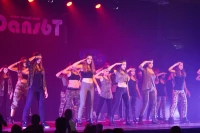
Yes, absolutely—for me, for the company, and for the dancers involved in the production. We’ve gone from about twenty performances a year to over sixty. We’re reaching places we otherwise never would have visited. We performed at the festival in Goult, and at the festival in Ramonville, where we had an audience of 1,800 one night and 1,500 the next. I’ve performed before larger crowds before—for instance, at Les Eurockéennes de Belfort—but that was as a supporting act for a singer. This time, it’s for us, and for dance itself. People are seeing us, talking about us, and it’s opening new doors. And what’s more, we’re pleased that this is happening with this particular show, as it’s practically a history lesson. We also involve non-professionals and invite audience members to take part, so that we can all share the experience together.
A participatory show, a show performed in high schools—do you enjoy reaching out directly to audiences?
Yes, it’s important to do so. It helps address the audience’s need to understand the themes of a performance, regardless of whether they are regular theatergoers or not. We strive to engage a diverse audience; we work with schools and nursing homes (EHPADs) to reach people of all ages. We aim to connect both with those who are accustomed to the performing arts and with those who might think that a dance performance isn’t for them—the goal is for everyone to share in the experience together. The strength of hip-hop lies in its ability to draw inspiration from a wide variety of sources; for instance, you can take gestures from soccer players and transform them into dance movements. Furthermore, fostering this connection with the audience helps them develop a perspective—a critical eye—on what is being presented to them.
At the Parvis’s "Fest-Nov" festival, you are presenting *Révérence* at the end of a residency. Are you taking your final bow?
No. Coraline Lamaison and I decided that, given my age, it might be the right time to create a solo piece. We’ll be presenting an initial glimpse of what it could evolve into—a *Boléro* that gradually incorporates more and more elements. It’s a "bow" (*révérence*) to all the dance styles that have accompanied me throughout my life. I’m not taking my final bow—though, watching young people dance, I do realize that there are certain things that are no longer suited to my age.