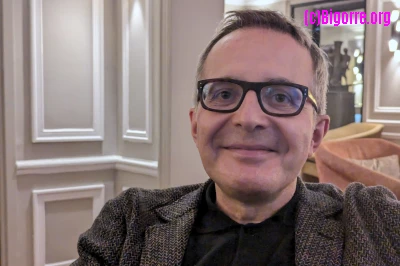
Il est sur tous les fronts de la littérature. Ecrivain d’abord avec six romans, de la poésie et des essais, traducteur de Oscar Wilde ou de James Joyce, éditeur chez Grasset. Sur le front de la radio aussi où il produit et anime des émissions autour de la littérature et plus largement de la création artistique sur France Culture depuis plus de dix ans. C’est aussi un tarbais qui fait sa scolarité dans la capitale Bigourdane de l’école Voltaire au Lycée Théophile Gautier en passant par le collège Desaix. Avant de partir pour une autre capitale. Rencontre dans un salon de la Rue des Saints-Pères à Paris.
Est-ce que votre enfance tarbaise est très loin de vous ?
Loin dans le sens géographique oui, dans le sens personnel et sentimental ce n’est pas tout à fait vrai. Je n’ai plus de famille là-bas. J’ai gardé un souvenir d’enfance de voir cette barrière des montagnes qui avait l’air d’un obstacle, de quelque chose à franchir. Mais je pensais aussi à ce que Tarbes compte d’écrivains. Théophile Gautier est né à Tarbes. La famille de Jules Laforgue était de Tarbes. Lautréamont aussi. Ça voulait dire que cette ville qui était un peu au fond de tout, près de cet obstacle des montagnes et très lointain par rapport à la capitale où les choses artistiques se passent et finalement ce n’est pas si loin et ça comptait.
Comme le personnage de votre roman, vous avez quitté Tarbes pour Paris
Oui je suis parti après le bac, il y a eu Toulouse pour des études. Et puis Paris parce que la France est ainsi faite que maintenant et je crois pour longtemps on ne peut être écrivain qu’en étant à Paris. Les éditeurs sont là, on rencontre les gens ici, parce que c’est comme ça. Paris est la capitale artistique de la France, ça n’a rien de péjoratif pour les autres qui ont d’autres qualités mais c’est resté comme ça. La plupart des grands écrivains sont des provinciaux venus à Paris. Paris devrait nous remercier parce que nous, les écrivains provinciaux, irriguons Paris.
Comment devient-on écrivain trois ans après une thèse de droit aérien ?
Le droit, c’était des études qui n’existaient pas dans ma famille et je voulais qu’on me foute la paix. J’aimais beaucoup la littérature mais je ne voulais pas faire d’études littéraires qui me dicte quoi penser de la littérature. Je lisais beaucoup, j’écrivais. J’ai eu un parcours comme tout le monde, publiant des articles dans des revues. Le directeur de la revue m’a dit que je devrais écrire un livre. Il a été publié et j’ai eu la chance d’être salué par les plus grands critiques de l’époque qui était Angelo Rinaldi, Bernard Frank. Le premier livre c’est facile, même quand on ne connaît personne. C’est après que c’est difficile.
Etre écrivain et éditeur, c’est écrire et se regarder écrire ?
Je crois que tout écrivain et son propre éditeur parce qu’on passe son temps à se relire à se corriger. La chose la plus difficile de savoir se corriger et arriver à se lire comme si ce n’était pas soit. Après être écrivain et éditeur en même temps c’est aussi faire partie d’une longue continuité d’écrivains-éditeurs comme l’ont été Cicéron, Virginia Woolfe, Rémi Gourmand, André Gide. Je pense que c’est la spécificité de certaines maisons d’édition parce qu’un écrivain éditeur n’est pas la même chose qu’un éditeur qui n’est qu’éditeur.
Pas de roman depuis huit ans. C’est la radio qui vous absorbe ?
Non, je ne crois pas. Je vais publier un nouveau roman en janvier. Vous avez la nouvelle car ce n’est pas encore annoncé. Et la radio, je viens tout juste d’arrêter.
J’ai l’impression de ne rien faire
Ce n’est pas un paradoxe et ce n’est pas exceptionnel du tout
explique Charles Dantzig qui passe de l’écriture au micro en passant par le travail d’édition chez Grasset. Quand on a envie de quelque chose on a toujours le temps. C’est mon cas. Evidemment je sacrifie beaucoup de choses de ma vie : pas de maison de campagne, pas de famille parce que je l’ai voulu pour me consacrer à la littérature. Il ne faut surtout pas rester à rêver. Les gens qui rêvent ne font rien parce que le rêve est un supplétif. Pendant qu’on rêve on ne fait rien
.
 @bigorre_org