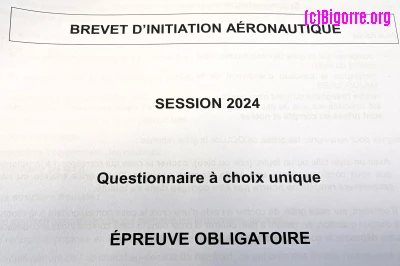
C’est un sujet dans la veine des sessions précédentes. Les 100 questions du BIA 2024 que les candidats ont découvert lors de l’épreuve de jeudi sont dans l’esprit des précédentes épreuves du Brevet d’Initiation Aéronautique. Intéressantes pour la plupart, mais pas toujours. 20 questions de météorologie et d’aérologie, 20 questions d’aérodynamique, d’aérostatique et des principes du vol, 20 questions d’étude des aéronefs et des engins spatiaux, 20 questions de réglementation, de navigation et de sécurité des vols, 20 questions d’histoire et de culture aéronautique et spatiale. Et pour ceux qui se sont inscrits à l’épreuve facultative, 20 questions supplémentaire d’anglais aéronautique.
Des questions souvent intéressantes, mais pas toujours
L’essentiel des questions posées permettent de couvrir une bonne partie du programme du BIA. Mais on retombe cette année encore dans les travers des sessions précédentes avec quelques questions qui n’ont rien à faire dans un sujet d’examen destiné à des jeunes qui font leurs premiers pas dans le secteur. Des questions anecdotiques, ambiguës ou clairement trop difficile. Au point que bien des formateurs du BIA patenté par leur Certificat d’aptitude à l’enseignement aéronautique restent perplexe devant l’intention des auteurs. Avec à la clef l’effet délétère sur des candidats désemparé face à des questions qui leur échappe. En tant que formateur, on a plutôt envie de rassurer, de valoriser les connaissances fondamentales de l’aéronautique.
Des questions anecdotiques comme…
C’est le syndrome du copinage. Des questions qui n’ont d’autre qualité que de faire plaisir à une des fédérations aéronautiques ou à un autre partenaire du BIA. Et tant pis si on n’est pas de ce cercle. En 2022, c’était le nombre de classe d’ULM suivi deux questions plus loin d’une autre sur le numéro de la classe d’un paramoteur. Pourquoi pas l’âge du commandant de bord ?
La session a été plus raisonnable en la matière, même si on retrouve a la question 4.3 le sigle correspondant à la fédération regroupant les hélicoptères. Ce qui de plus ne va pas plaire à la FFPLUM qui regroupe les hélicoptères en classe ULM.
Des questions ambiguës comme…
Dans la 3eme partie, celle de l’étude des aéronefs et des engins spatiaux, la question 3.5 sur l’indicateur de virage a des propositions qui se recouvrent. Le virage a droite englobe le virage a droite asymétrique.
Des questions excessivement difficiles comme…
La 3eme partie, celle de l’étude des aéronefs et des engins spatiaux a été riche en la matière. La question 3.8 sur le taux de dilution d’un turboréacteur double flux dépasse les connaissances dispensées par le formateur. Même si la réponse n’est pas difficile à trouver, la question est inutilement trop ambitieuse. La question 3.16 pour savoir si le plan canard est porteur ou déporteur et s’il décroche avant ou apres l’aile. Et encore dans cette même partie la question 3.20 sur les turboréacteurs simples ou doubles corps et simple ou double flux.
Et dans la partie suivante, celle de la Navigation, règlementation, sécurité des vols, la question 4.18 de savoir si la DME mesure une distance sol ou une distance oblique.
 @bigorre_org