Le magazine américain vous considère comme « la fille spirituelle de Django Reinhardt et Billie Holiday.». Est-ce que vous vous reconnaissez dans cette paternité ?
Oui et non car mais je ne pense pas avoir la même voix de Billie Holiday, mais je viens effectivement du jazz. J’étais beaucoup accroché à la voix d’Ella Fitzgerald et la musique gypsy m’a aussi beaucoup influencée
Pourtant vos racines sont ancrées de notre coté de l’Atlantique
L’histoire de la musique et l’histoire des hommes surtout montre que ce qui s’est passé de l’autre coté de l’Atlantique prend racine en Afrique. Je viens du grand sud marocain et je ne fais que me réapproprier ce qui est déjà culturellement africain, qui est culturellement de chez moi. Au Maroc c’est chanté en berbère ou en langue malienne, mais les notes sont déjà les gammes pentatoniques de blues. Et les rythmiques aussi. J’ai pioché dans ces différentes origines, dans les différentes cultures pour faire ma propre cuisine.
C’est comme ça que vous avez conçu votre album « Hand Made » ?
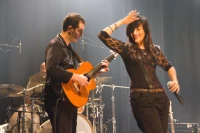
Hand made c’est fait main, c’est de l’artisanat. Pour moi, la musique c’est de l’artisanat, elle le sera toujours. Même quand on travaille avec des machines, l’électro c’est toujours de l’artisanat parce qu’on travaille avec ses mains. Pour moi, c’est essentiel d’avoir une pratique comme ca, de créer pour les autres. Comme un ébéniste qui met de la concentration, de l’énergie dans son travail créatif. C’est un don à l’autre. Et c’est la même chose sur scène. Il faut donner aux autres. La musique c’est fait pour créer un mouvement. Pour moi c’est tellement important. C’est comme ça que je partage mon métissage avec les autres.
Vous êtes donc pleinement dans l’esprit « Jazz métis » de cette semaine au Parvis !
C’est très bien comme ca. On revoit dans les festivals de jazz des musiques différentes, on voit de la musique africaine qui rentre dans le jazz. C’est bien ca le jazz, un grand métissage entre la culture noire et la culture blanche. C’est un mélange qui crée d’autres ouvertures. Le jazz a quitté ce costume rigide embarrassant qui allait rejoindre la musique classique, figée et élitiste. Le jazz est une musique populaire et doit le rester !
 @bigorre_org