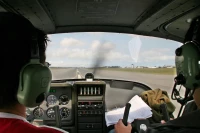
On Thursday, May 30th at 2 PM, candidates will discover the 2024 exam topic for the Aeronautical Initiation Certificate (BIA). Just a few weeks remain to complete a year of exploring aeronautics, its culture, history, vocabulary, and challenges through courses, often including visits to military air bases, control towers, airports, and manufacturers if one is fortunate enough to prepare for the BIA in an aeronautical region. And in most cases, flights are included when the local flying club, gliding club, or model aircraft club allows it.
The 2024 BIA exam will feature 100 multiple-choice questions on meteorology and aerology, aerodynamics, aerostatics and the principles of flight, the study of aircraft and spacecraft, navigation, flight regulations and safety, and the history and culture of aeronautics and space. And 20 additional questions for those who chose the aeronautical English option.
What to do before the BIA
Practice with past papers. When you don't understand a question or its answer, take the time to review the lesson or ask for an explanation. After a year spent understanding how an airplane flies, how it navigates, and how it integrates into an environment where light aircraft land on the same runways as the largest airliners, past papers help you understand what is expected of candidates. They also allow you to practice with familiar questions that may reappear in the 2024 BIA. Past BIA papers from recent years are available on Bigorre.org. More than 1,000 questions to practice and understand what is expected of young people from age 13 who are discovering aeronautics. If you know the answer, you're guaranteed a point. Otherwise, eliminate the answers you think are wrong; this will increase your chances of getting it right. In any case, don't choose multiple answers, or none at all, because that's the only way you're certain to miss the point.
This will allow you to gain confidence, become aware of what you already know, and identify what you need to review. Don't wait until you feel completely ready for the BIA: the reasonable goal isn't to get 100/100, but to pass the BIA, perhaps with honors.
Also, take the time to breathe, get some fresh air, and rest. As with all the exams you've taken, and will take, it's best to be in top form!
What does the 2024 session have in store for us?
But we're not privy to the details, nor are we aware of any potential leaks. However, we can anticipate the impact of current events. We can only recommend that candidates stay informed about current aeronautical news. Topics being discussed include the environmental impact of aviation, the war in Ukraine, and the increasing use of military drones. We're also thinking about anniversaries, though we can't pinpoint any major events celebrating their centenary or fiftieth anniversary in 2024.
On the Day of the BIA
Prepare your exam invitation and a piece of identification such as your ID card or passport. This will prevent last-minute stress for both you and the exam center. The BIA consists of 100 multiple-choice questions, each with four possible answers. There is always one correct answer, and only one correct answer. For each question, you must therefore select one and only one box. Not answering or selecting two boxes will result in a point deduction. Don't be alarmed by a few poorly worded or excessively difficult questions, as you only need 50/100 to pass the BIA. And as a last resort, you can always rely on luck, since there are no penalty points on the BIA: you therefore have at least a one in four chance of finding the correct answer. This is even more likely if you eliminate incorrect options.
Be careful not to confuse the exam paper with the answer sheet: always check that the question number corresponds to the line you are filling in on the answer sheet. Proofreading at the end of the exam is the final check that should make any discrepancies impossible.
You have plenty of time. Two and a half hours for 100 questions means an average of 1 minute 30 seconds per question. It's likely you'll need much more time than that. You can start by answering the questions you know how to handle, marking the ones you skip. Then, take the time to tackle the questions that seem more time-consuming without the pressure of the deadline. Here too, it's essential to reread your answer sheet to gain some perspective on what you've done. Good luck to all the candidates with these final revisions, and see you on Bigorre.org for the 2024 BIA answer key!
 @bigorre_org