What can you see at the museum?
This museum was created in the 19th century in the residential building that Placide Massey bequeathed to the city, along with its garden. It was Member of Parliament Achille Jubinal who championed this project. He donated some of his own collections. And since he was very well connected at the court of Napoleon III, he also inquired about donations to open the museum. He amassed a collection of pieces for the museum, which opened in 1863. This was the Fine Arts collection, featuring paintings from the 15th to the 19th centuries. Then, in the 1950s, curator Marcel Boulin collected folk art to create a Bigorre and Four Valleys collection, which now boasts over 8,000 objects.
And the Hussar Collection!
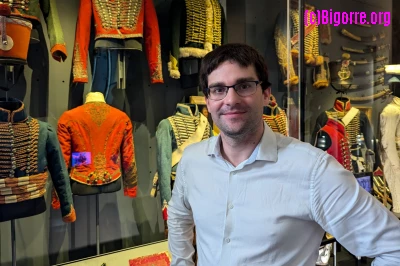
In the 1960s, Marcel Boulin was asked to specialize the museum. He thought about horses, which led him to the hussars, for whom there was a certain fascination at the time. In about twenty years, he built up a collection of 18,000 objects from many countries. This is why it's considered an international museum.
How are these collections used?
With the 2012 renovation and the "Musée de France" designation, we focused the museum on a single theme: the hussars. They represent a large part of our holdings. This has become the museum's permanent collection. The works from the fine arts collection are presented in the two or three temporary exhibitions we present each year. And we don't exhibit the Bigorre and Quatre Vallées collection to the public because we can't show everything.
Hussars for specialists or for the general public?
With 18,000 pieces, it's obviously a prime destination for those interested in military history. But it's also a theme that allows visitors to see a great deal of art. Uniforms and weapons, of course, but also paintings, like the Casanova painting on loan from the Louvre, sculptures, handcrafted uniforms, and engraved objects. Pieces that appeal to a wider audience, who can come and even return. I myself rediscover new things every day.
How do you manage such an eclectic fine arts collection?
It doesn't allow for monographic exhibitions because we don't have 30 works by the same artist. We prefer thematic exhibitions, which, on the contrary, benefit from having such a diverse collection.
What to see now at the Massy Museum
First, there's the permanent exhibition dedicated to the hussars, with a collection of uniforms, weapons, and artifacts that help to understand the history of these mercenaries. And in two large rooms, there's a temporary exhibition dedicated to the contemporary artist Antonio Saura, celebrating the 60th anniversary of the twinning with Huesca.