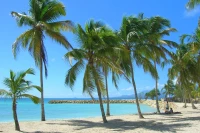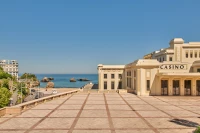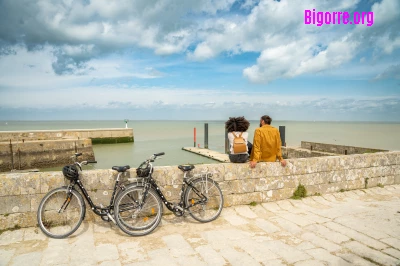
From Île de Ré to Île d’Oléron, passing through La Rochelle and Marennes, the Charente coastline boasts some of the most beautiful scenery on the Atlantic coast. La Rochelle and its Old Port, with its medieval towers, seem to stand guard over the ocean. The vast beaches, such as Boyardville with its wide expanse of fine sand on Île d’Oléron, Châtelaillon-Plage south of La Rochelle, and Trousse-Chemise beach on Île de Ré, create a diverse and inviting coastline. The islands themselves, starting with Île de Ré, where pine trees and dunes alternate with salt marshes that can be explored by bicycle, continue on to Île d’Oléron, Île d’Aix, and the very popular Fort Boyard. These images evoke a sense of travel, whether for a weekend getaway, a long weekend in May, or a longer holiday, as Charente-Maritime is a popular summer destination.
But here, there are no concrete blocks like in neighboring Vendée, nor tourist developments built with disregard for the environment. In Charente-Maritime, tourism is committed to sustainability. Often cited as an example for its ability to balance high visitor numbers with the preservation of natural sites, this approach, while not perfect, remains a source of inspiration for other regions.
Preserving Natural Areas
Very popular during the summer months, particularly along the coast and on the islands, Charente-Maritime has implemented a responsible management approach to its natural spaces, limiting excessive urbanization and protecting sensitive areas such as marshes, dunes, and nature reserves. Numerous protected sites exist, both along the coast and inland. Examples include:
- The Moëze-Oléron National Nature Reserve, a vast area of mudflats and salt marshes between the Île d'Oléron and the mainland, classified as a site of international importance for the wintering and migration of birds.
- The Marais d'Yves National Nature Reserve, between La Rochelle and Marennes, which protects a network of dunes, marshes, reedbeds, and meadows that host hundreds of bird species and remarkable flora.
- The Lilleau des Niges National Nature Reserve, on the Île de Ré, developed on former salt marshes and now a major ornithological site on the Atlantic coast.
- Further north, the Bay of Aiguillon, a major wetland in the Marais Poitevin, essential for many waders during migration or wintering.
- Inland, about ten kilometers from Marennes, the La Massonne Regional Nature Reserve, nestled between marshes and heathland, is renowned for its great diversity of plants, dragonflies, butterflies, and bats. Also noteworthy are the sites bearing the "Échappées Nature" (Nature Escapes) label, such as the Moins cabin, the Marais aux Oiseaux (Bird Marsh), and certain areas of the Marais Poitevin and Moëze-Oléron, which form a network of sensitive natural spaces open to the public, managed ecologically and offering educational programs.
Preserving Charente Heritage and Identity
Built heritage is also omnipresent along this coastline. This is particularly true of La Rochelle, which boasts an exceptional legacy linked to its maritime past. From the historic center to the Port des Minimes, a stroll through the pedestrian streets allows visitors to immerse themselves in the local culture before arriving at the Old Port, passing through lively squares and charming neighborhoods. The town center is located within a protected area designed to reconcile heritage preservation with evolving uses. More broadly, the town integrates environmental and energy considerations through a territorial planning scheme aimed at limiting the consumption of agricultural and natural land, particularly to combat urban sprawl.
The oyster farming villages and fishing ports are reminders of the deep-rooted local maritime culture, with their colorful huts, wooden jetties, and tanks where oysters and shellfish mature. Promoting local expertise, from oyster farming to farmers' markets, is essential for welcoming millions of visitors without altering the landscape. Even though the Cité de l’Huître (Oyster City), south of Marennes, recently closed after twenty years due to insufficient visitor numbers, oyster farmers remain numerous between Marennes and Oléron, shaping the landscape and identity of the region.
Preserving to Build Sustainable Tourism
This approach seeks a balance between tourist appeal and environmental protection, aiming to offer a rich experience while respecting the environment and the spirit of the Charente region, based on a lifestyle centered on the ocean, nature, and simplicity. Proof that preservation is not the enemy of tourism, but rather a
 @bigorre_org