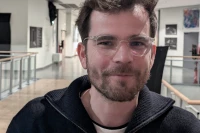
![Sébastien Bournac en résidence au Parvis pour <q>Sans suite [Un air de roman]</q>](/imgm/20260302_sebastien_bournac.webp "Sébastien Bournac en résidence au Parvis pour <q>Sans suite [Un air de roman]</q>")
What interests you about the musical form?
I've always thought that theater isn't just about the text, but that the staging can incorporate other elements. The work on the set design, the actors' work, the costumes, the music. Music is very important to me. What interests me is the diversity of registers and narrative styles that can emerge on stage and be juxtaposed. It's not a play that unfolds through dialogue from beginning to end. When a song arises from a scene, it takes us to other planes, other levels, and other feelings for the audience as well. It's the spectacle and this blend that interest me. I believe that theater is a total art form. The musical is about rediscovering the fundamentals of theater. The Greeks already had music, acting, and costumes. It's a way of reconnecting with a very popular form of theater. It's a joyful show, with eight people on stage. It's very open and appeals to all audiences.
Baptiste Amann told us that you describe the show as a "frustrated musical." Is that a good description?
That might not be the most accurate term. Baptiste plays with the conventions of musical theater, with musical theater references. This applies to the themes, such as a love triangle or a difficult ordeal for one of the protagonists, as well as to the form, the diversity I mentioned earlier. And we also realized that sometimes in musicals, everything tends to go in the same emotional direction. There, the music was also sometimes used to disrupt the intended play. For example, he wrote a very beautiful scene in the show where the main characters are discussing a very important game, while the music is very loud because there are bands playing. It creates a disruption, a complexity in the experience, and that's quite interesting. I like this juxtaposition, like in life. You can be going through a difficult time, a bereavement for example, and be next to a bar where people are partying. It's the juxtaposition of emotions that's beautiful. But you don't see that in traditional musicals, which tend to smooth over the rough edges. Naturally, if you're expecting a Broadway-style musical, you're going to be a little disappointed because it's a contemporary musical set in a contemporary story. I sometimes say it's a musical with songs because it's a musical, and that creates a certain level of expectation. Nevertheless, the pleasure remains the same.
What did you ask Baptiste Amann when you asked him to write the play?
When I wanted to work with Baptiste, whose work as a writer and director I know well, I knew I shouldn't be on the same level as him in staging these texts. I chose the form by asking him to write a musical, even though he wasn't used to writing, to shift away from his traditional work, to explore a different territory, and because my previous shows often featured musicians and songs, and I wanted to really confront a stronger interplay between music, songs, and a fictional situation. And I chose the theme: the story of a man in the middle of his life, going through a crisis, collapsing before our eyes for no apparent reason. The story of a collapse, the journey through that collapse towards something brighter. And Baptiste delivered a magnificent story.Is the text delivered by Baptiste Amann sacred, or has it evolved?
No, it's not sacred. The play was commissioned three and a half years ago. He delivered it to me two years ago. We entered a long period of discussion and dialogue around the play. It evolved a little. He rewrote some things, he modified others. A year ago, we also met with the entire cast. We talked, we studied the text. We really delved into the issues at stake. And he actually rewrote some things right up until last December. The play has been in motion, but always in dialogue with Baptiste. Now, we don't rewrite anything, but sometimes we cut or remove small things. He's even gone back to a section he had removed during the text's evolution. So it's truly a dialogue with the author. The text isn't sacred; Baptiste writes for the stage, for the actors. He has always given us the freedom to ask him questions if anything is unclear. And if the stage requires something else, to discuss it with him so that it best meets the demands of the performance.
Next Wednesday is the premiere at Le Parvis. Will the show be completely finalized and set in stone?
I believe that shows begin to come alive, to grow, when they encounter an audience. Right now, we have many questions about how the audience will engage with it. How they will connect with it, how they will create a story. Because I think there will be as many interpretations as there are spectators. It will be the beginning of another phase of work. It's a live performance that never truly settles. It depends on the venue, the actors' mood, and the audience. We can make changes if things seem unclear. But let's just say that on March 11th, everything we wanted to present will be there.
What will happen after the premiere at Le Parvis?
This year there's a tour of national theaters. We're starting in Tarbes, then Bayonne, Albi, and Tulle, which have joined forces to support the show. In November, we're taking it on a national tour. We're doing a revival at the National Drama Center in Montluçon, which I now direct. Then in December, we have two weeks of performances in Paris. After that, we continue with Toulouse, Narbonne, Sète, and Ivry. For now, we have about thirty performances scheduled, and it could tour even further into the following year.
 @bigorre_org