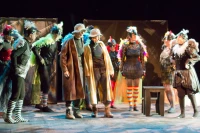
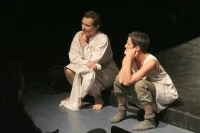
Starting this Friday, Le Pari presents Women of Mud, Women Standing Tall
, a six-performance production that explores women's perspectives on war. We immediately think of the perspective of women victims in Kosovo, Rwanda, or elsewhere, throughout the course of conflicts. It is more difficult to imagine how they see their surroundings. This is what the women of Théâtre du Matin and Théâtre de la Bulle offer us with two plays written by contemporary male authors.
The first play is On the Sex of Women as a Battlefield
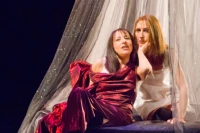
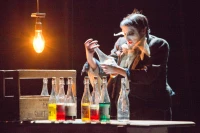
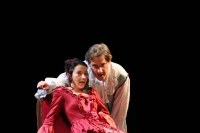
by Matéi Visniec. Quite a statement! The intertwined destinies of two women transformed by the war in Bosnia. Dora, scarred in her body by rape, this method of warfare, a mixture of violence and sexual domination that leaves a woman destroyed and a child whose blood bears witness to the ethnic conflict. She watches this child, whom she considers a stranger, grow into a cancer that eats away at her from within. Opposite her is Kate, an American woman who came to Europe to provide psychological support to those identifying bodies in the Srebrenica mass graves. But with no one supporting the psychologist, she broke down and asked to take some time away from this monstrous reality. Two paths that meet—collide, in a sense—in a NATO clinic. The text, uneven, is at times very intense: it presents a brutal image of this dramatic situation, giving form to a pain that is rarely discussed in the media. Nathalie Lhoste-Clos's portrayal of a Dora ravaged by what she is enduring makes the viewer uncomfortable, perhaps even more so the female viewer. We warned you, this is not a farce!
After this first play and a short intermission that may offer some respite, Jean-Pierre Siméoni's Stabat Mater Furiosa
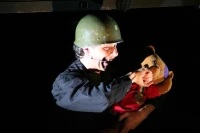
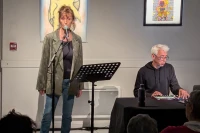
awaits you. This is not the Virgin Mary's grief over her crucified son, but a woman's fury in the face of war. This contemporary author has imagined "the voice of a woman, freed as much as possible from the dolorism imposed upon her by age-old conventions, words raised in brutal and relentless invective against the filth of perpetual murder." The text offers a timeless and introspective perspective on the previous play. Highly symbolically, the set for this play is the hidden side of the set for the first part of the evening. "One can imagine that it is the child born from Dora's womb who speaks," suggests Mercedes Tormo, who directed both plays. Françoise Delile-Manière launches into this long monologue in her deep voice, with great intensity, a monologue that a rather seventies-style staging attempts to pace. The staging is a difficult exercise; you have until October 21st to form your own opinion.
 @bigorre_org